
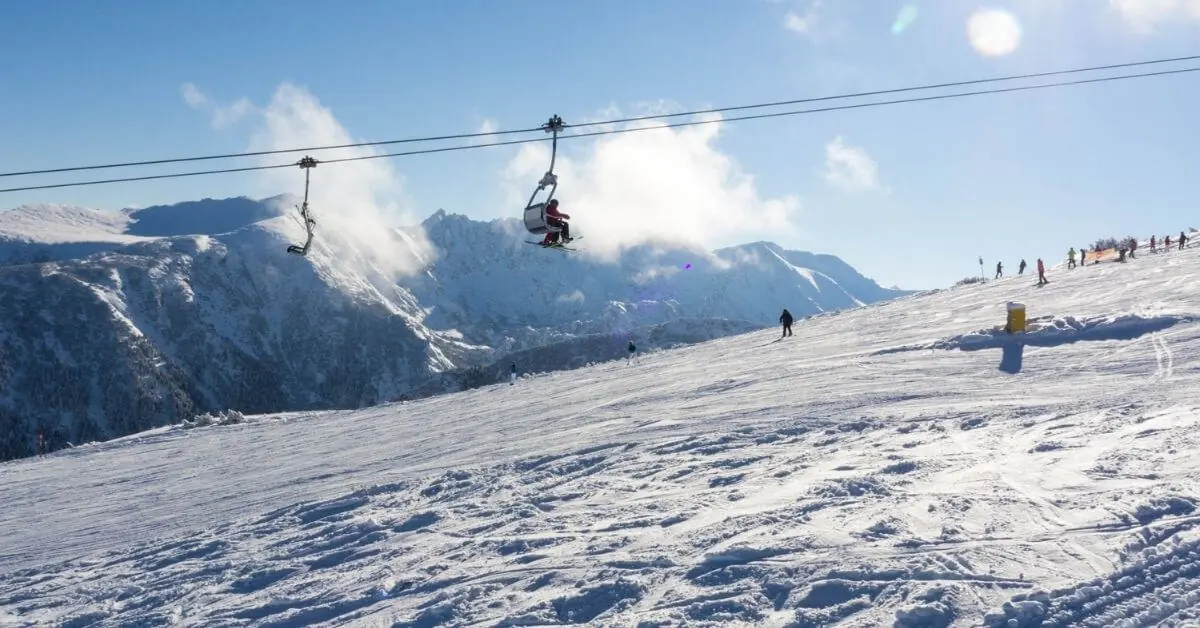
Bansko is the busiest ski resort in this part of Europe — and there’s a reason for it. The mountain has the most extensive lift system in the Balkans, the snow reliability of the Pirin range above 2,000 meters, and prices that have kept it among Europe’s better-value ski destinations year after year. We drive guests from Sofia Airport to Bansko almost daily through the season, and the question we get most in the car is the same one most travelers ask online: what’s actually true about Bansko, and what’s marketing?
This post is the version we’d answer over coffee — what Bansko offers in 2025/26, what it costs, where it lives up to the hype, and where it falls short. Practical from a chauffeur’s seat.
Where Bansko Is and How to Get There
Bansko sits in southwestern Bulgaria, at the foot of the Pirin Mountains, about 160 km south of Sofia. The town itself is at 936 meters, the ski area runs from 990 m at the gondola base up to 2,560 m at Todorka peak.
Distances we deal with daily:
- About 160 km from Sofia Airport — 2 hours 30 minutes by car on the new highway sections, longer if you hit weekend ski traffic
- About 200 km from Plovdiv Airport — 3 hours by car
- About 230 km from Skopje, North Macedonia — 4 hours plus border crossing
- About 260 km from Thessaloniki, Greece — 4 hours plus border
The Sofia–Bansko road has been progressively upgraded over the past few years. Most of the route is now highway or improved two-lane road, with the slowest section being the climb up to the Predel pass and the descent into Razlog. Snow chains can be required on the upper sections after heavy snowfall — police occasionally turn back vehicles without proper winter equipment. Our vehicles run on winter tires through the season and carry chains.
For travelers from outside Bulgaria, we run regular transfer routes:
- Sofia Airport to Bansko — the most-used route by far
- Plovdiv Airport to Bansko — useful for Wizz Air arrivals from Western Europe
- Skopje Airport to Bansko — for travelers connecting via North Macedonia
The Ski Area: What Bansko Actually Offers
Bansko’s ski terrain is the largest in Bulgaria and one of the largest in the Balkans:
- Around 75 km of marked slopes — more than Jahorina, Borovets, or Pamporovo
- Three main ski zones — Chalin Valog (lower, beginner-friendly), Shiligarnik (mid-level technical terrain), and Banderishka Polyana (higher altitude, advanced runs)
- Top altitude at Todorka peak: 2,560 m — high enough for reliable snow December through April
- Modern gondola from town to the ski area at Banderishka Polyana — about 25 minutes ride, 6.2 km long
- Snowmaking system covering most slopes — extends the reliable skiing season
The Bansko gondola is one of the resort’s defining features — and one of the most criticized when you come at the wrong time. Morning queues at the gondola during peak weeks (especially Christmas, New Year, and February school holidays) can run 60–90 minutes. The trick is to arrive before 8:30 or after 10:30 to skip the worst of the wait.
Ski Lifts
The Bansko ski area uses a mix of lifts to move skiers between zones. Main lifts include:
- Bansko Gondola — 6.2 km, capacity 2,000 people/hour, connects town with Banderishka Polyana
- Kolarski — 6-seat, capacity 3,000/hour, services lower-area runs
- Mosta — 4-seat, services Shiligarnik area
- Banderitza 1, Banderitza 2, Plato — 4-seat lifts servicing Banderishka area
- Todorka — 6-seat to the top of the ski area at 2,560 m
- Shiligarnik — 4-seat servicing the technical mid-mountain runs
- Plus several drag lifts (T-bars and baby drags) for beginner zones
Ski Slopes
Bansko has roughly 17 named slopes ranging from beginner blue to expert black. Most-used:
- Slope #1 Kolarski — blue, gentle, beginner-friendly
- Slope #2 Banderitza — red, the resort’s signature run, hosts FIS World Cup races
- Slope #4 Balkaniada — red, classic Bansko terrain
- Slope #11 Plato — blue, popular with intermediates
- Slopes #5 and #10 Shiligarnik — red, technical mid-mountain
- Slopes #13 and #14 (above Todorka) — black, only accessible when conditions permit, dramatic views from the top
Working hours during the winter season: gondola 8:30 AM – 5:00 PM (last ride down from Banderishka Polyana), lifts open 8:45 AM – 4:15 PM. Lift Banderitsa runs from 9 AM, Lift Plato from 9 AM until 4 PM.
Bansko Ski Pass Prices for 2025/26
Bansko remains one of Europe’s better-value ski destinations and the most popular of the Bulgarian three (Bansko, Borovets, Pamporovo). Bulgaria adopted the euro on January 1, 2026 — all prices below are in euro. Some restaurants, ski shops, and accommodation listings may still show BGN alongside euro through 2026 as part of the official dual-display transition period, but you only pay in euro.
2025/26 standard daily lift pass (effective from December 14, 2025):
- Adult daily pass: approximately €33
- Half-day pass (from 12:30 onward): approximately €25
- Children 7–11.99: roughly 55% of adult price
- Children under 7 and seniors over 75: €0.50 — symbolic price
- Students: 10% discount with valid ID
- Multi-day passes work out cheaper per day
- Seasonal pass: approximately €870
Discounts are available when booking ski equipment and lessons together with the lift pass through Ulen (the resort operator) — typically 10–15% off the lift pass with full equipment rental.
Ski Equipment and Rentals
Bansko has dozens of ski rental shops scattered around the gondola base and through the town. Quality varies significantly — some shops carry well-maintained current-season gear, others are noticeably older.
- Daily ski/snowboard rental: typical range 15–35 EUR depending on equipment quality and shop
- Premium rentals (recent-season skis, performance boots): 30–50 EUR per day
- Most shops offer multi-day discounts — booking 5+ days drops the per-day rate by 15–25%
- Pre-booking online through Ulen or independent shops typically beats walk-in prices by 10–15%
- Free ski storage at most rental shops at the gondola base — leave your equipment overnight rather than carrying it back to your hotel
Established rental names that come up regularly with our clients: Ulen Rental (the resort operator’s own service), Tsakiris Ski (independent, well-reviewed), and several smaller shops in the gondola base parking area.
Ski Lessons and Instructors
Bansko has a deep ski school infrastructure thanks to decades as Bulgaria’s premier resort. Approximate 2025/26 rates:
- Group lesson (3–12 people, 4 hours): around €40–60 per person per day
- Private lesson, 1 person, 2 hours: approximately €99
- Private lesson, 2 persons, 2 hours: approximately €156
- Private lesson, 1 person, 4 hours: approximately €176
- Junior Ski School (ages 4–7.99, full-day with lunch): includes equipment, lessons, games, lunch — full-day care option for parents
Most instructors at the larger schools speak English; many also speak German, Russian, and Hebrew (reflecting Bansko’s main international markets). Group lessons fill quickly during peak weeks — book in advance.
Après-Ski and Restaurants

Bansko’s après-ski reputation is the most polarized aspect of the resort. To some travelers, it’s a major draw — to others, it’s the reason they’d skip Bansko. Both reactions are valid.
What Bansko Après-Ski Actually Looks Like
- Strong British and Israeli ski group presence — Bansko has been heavily marketed in both markets for 15+ years, and that crowd shapes the evening atmosphere
- Many “ski bars” near the gondola base open from afternoon onward — Happy End, Avalon, Lions, Velvet, and others
- Live music and DJ nights are common at the larger venues
- Cheap drinks compared to Western European resorts — beer typically €1.50–2.50
- Old town center has more traditional Bulgarian taverns (mehana) for a quieter evening
Restaurants Worth Knowing
Beyond the bar scene, Bansko has a serious restaurant infrastructure. Names that come up consistently:
- Mehana Dedo Pene — traditional Bulgarian, in a 19th-century house in the old town. Folk music nights, popular with first-time visitors
- Mehana Bansko — central, traditional, large enough for groups
- Come Prima — upscale Italian, elite dining option
- Victoria — local fish and seafood, good wine list
- Restaurant Plato on the mountain — best mid-day meal you can get above the gondola, panoramic views
- Several traditional mehana in the Banya village (5 km from Bansko) — cheaper, more local feel, worth a taxi ride if you want to escape the resort vibe
Average traditional dinner with wine in Bansko: €15–25 per person. Italian or upscale: €30–60 per person.
Where to Stay in Bansko
Bansko has more accommodation options than any Balkan ski resort — more than 200 hotels and apartment complexes for a town of about 8,000 permanent residents. The main categories:
- Luxury 4–5 star hotels: Kempinski Grand Arena, Lucky Bansko, Premier Luxury Mountain Resort, Regnum Apart Hotel and Spa, Four Points by Sheraton — all offer pools, spas, and ski-in/ski-out or shuttle access. Peak week rates €150–350/night
- Mid-range 3–4 star: Hotel Pirin, Hotel Bansko, Belvedere Holiday Club, Sport Hotel — comfortable, full amenities, peak rates €70–150/night
- Apartments and aparthotels: often the best value for groups and longer stays — kitchen facilities, more space, peak rates €60–120/night for a 1–2 bedroom
- Old town guesthouses: traditional architecture, family-run, more atmospheric, peak rates €40–80/night
Most of the larger hotels offer free shuttle service to the gondola base. The town itself is walkable end-to-end in 15–20 minutes, but in heavy snow that walk to the gondola feels longer than it sounds.
Booking: Christmas/New Year and mid-February school break weeks need 3+ months advance booking to get good options. January and March (outside school holidays) usually have availability much closer to your dates.
Nearest Airports to Bansko
Sofia Airport is the obvious primary entry point. Plovdiv works for some carriers. A few alternatives can be worth considering depending on your origin:
- Sofia Airport (SOF) — 160 km, 2h 30min, the standard. Largest flight network in Bulgaria, most international carriers
- Plovdiv Airport (PDV) — 200 km, 3 hours. Smaller, primarily Wizz Air seasonal routes from Western Europe
- Skopje Airport (SKP) — 230 km, 4 hours plus border. Useful if you find a much cheaper flight via North Macedonia
- Thessaloniki Airport (SKG) — 260 km, 4–5 hours plus border. Good for travelers from Greece, Turkey, Israel, and routes via Athens
For most international visitors, Sofia is the right answer. The flight network is wider and the transfer time is shortest.
Bansko Alternatives in Bulgaria and the Region
If Bansko’s crowd or atmosphere doesn’t suit you, several alternatives are worth knowing about:
Borovets (Bulgaria)
About 70 km from Sofia (1 hour 30 minutes), at 1,350 m elevation. Smaller ski area (about 58 km of slopes), more family-oriented, less party-heavy than Bansko. Often a better fit for travelers who want Bulgarian skiing without the British/Israeli ski group scene. Cheaper accommodation. Our Sofia to Borovets transfer handles arrivals throughout the season, and our separate guide covers the best restaurants in Borovets for evenings off the slopes.
Pamporovo (Bulgaria)
In the Rhodope Mountains in southern Bulgaria, about 240 km from Sofia. Beginner and intermediate friendly, lots of sun, smaller and quieter than Bansko. Good for first-time skiers and families with young children.
Jahorina (Bosnia)
If you’ve been to Bansko and want a different Balkan ski experience, Jahorina is the natural next step. About 30 km from Sarajevo Airport, 54 km of slopes, similar prices to Bansko but quieter atmosphere. See our full guide to Jahorina ski resort for the comparison.
Kopaonik (Serbia)
The largest ski resort in former Yugoslavia, about 70 km of slopes, 260 km from Belgrade. Higher altitude and more reliable snow than Bansko, but a longer transfer.
Tips for a Successful Bansko Ski Trip
- Avoid the Christmas/New Year and mid-February peak weeks if you can — gondola queues become genuinely punishing, accommodation is double the off-peak price
- Mid-January and March are the sweet spots for most travelers — good snow, much smaller crowds, lower hotel rates
- Book your gondola pass in advance online through Ulen — saves morning queue time
- Get to the gondola before 8:30 or after 10:30 to avoid the worst morning waits
- Bulgaria uses the euro — the country adopted euro on January 1, 2026, so no currency exchange needed for most travelers
- Eat at restaurants in the old town for better value and atmosphere than the mountain restaurants
- Consider an early morning walk in Bansko old town on a non-ski day — the cobbled streets and old wooden houses are beautiful in fresh snow
- Carry winter equipment in your rental car if you’re driving yourself — police occasionally enforce winter equipment requirements on the upper road sections
Why Renting a Car for a Bansko Ski Trip Usually Backfires
Two things go wrong consistently when international ski travelers try to rent a car for the Sofia-Bansko run. We see them every January and February.
The Luggage Problem
A group of four flying into Sofia with skis, boots, helmets, and full winter suitcases simply doesn’t fit in a Skoda Octavia or VW Golf — the standard rental cars at Sofia Airport. Roof boxes are not part of the standard fleet, and most agencies won’t have one available even if you ask in advance. The result is usually one of three things: someone’s gear stays at the hotel, the back-seat passenger rides with skis between their knees for 2.5 hours, or you pay an upgrade for a larger vehicle the agency may or may not actually have on the day. Our Bansko transfers run in long-wheelbase vans or large SUVs where four passengers plus full ski equipment fit without anyone repacking, disassembling poles, or sitting on top of bags.
The Mountain Road Problem
The Sofia–Bansko road is mostly highway, but the climb up to the Predel pass and the descent into Razlog turn into a different problem in heavy snow. Snow chains are sometimes mandatory on the upper sections — and the police do enforce winter equipment requirements during serious storms. Rental agencies in Sofia typically don’t include chains, and when they do, the renter is expected to fit them in -10°C with no experience. Our vehicles run premium winter tires through the season, carry chains in the boot, and our drivers know which sections are problematic in any given week. You sit in the back; we deal with the snow.
How We Help Clients With Bansko Ski Trips
Ski transfers to Bansko are different from regular airport transfers. The mountain road conditions, the weight of ski gear, the early-morning departures, the late evening pickups after dinner — all of it matters. Where having a private chauffeur actually pays off:
- Vehicles equipped for winter — winter tires through the season, snow chains carried, large luggage space for ski equipment
- Drivers who know the Sofia–Bansko road — including the back routes when the main highway gets congested on Saturday mornings
- No fixed schedule — flights run late, weather changes, plans shift; we adjust the same day
- Group transfers — ski groups, families, corporate ski weeks all benefit from arranged van or coach pickup
- One-way and onward routes — many clients combine Bansko with Plovdiv sightseeing, a Sofia visit, or onward travel to Greece, North Macedonia, or Turkey. We handle the cross-country leg as a single chauffeured day
- Mid-week transfers between resorts — for travelers wanting to combine Bansko with Borovets or even Jahorina across a longer trip
Our most-booked Bansko routes:
- Sofia Airport to Bansko — daily through the season
- Plovdiv Airport to Bansko
- Skopje Airport to Bansko
- Thessaloniki Airport to Bansko (cross-border)
- Bansko to Borovets and other Bulgarian ski transfers
Send us your dates, group size, equipment count (skis/snowboards/poles), and arrival airport — we’ll come back with a route and a quote the same day.
Get In Touch
Don’t hesitate to ask for a quote. Contact Balkan Chauffeur for your journey or renting a chauffeured car.
Related Posts

How to Get to Bansko in Winter: Why Private Transfers Beat Buses and Rental Cars
Winter trip to Bansko? Compare airports, buses, rental cars and private transfers—and see why pre-booked ski transfers are the easiest option.

Why Cross-Border Transfers in the Balkans Require Local Experience, Not Just a Driver
Cross-border transfers in the Balkans are fundamentally different from cross-border travel...

Top 10 Restaurants in Borovets: A Driver’s Recommendations After the Slopes
Where to eat in Borovets — 10 restaurants from traditional Bulgarian to Tex-Mex and Caribbean. Honest chauffeur’s picks for every kind of evening.
