
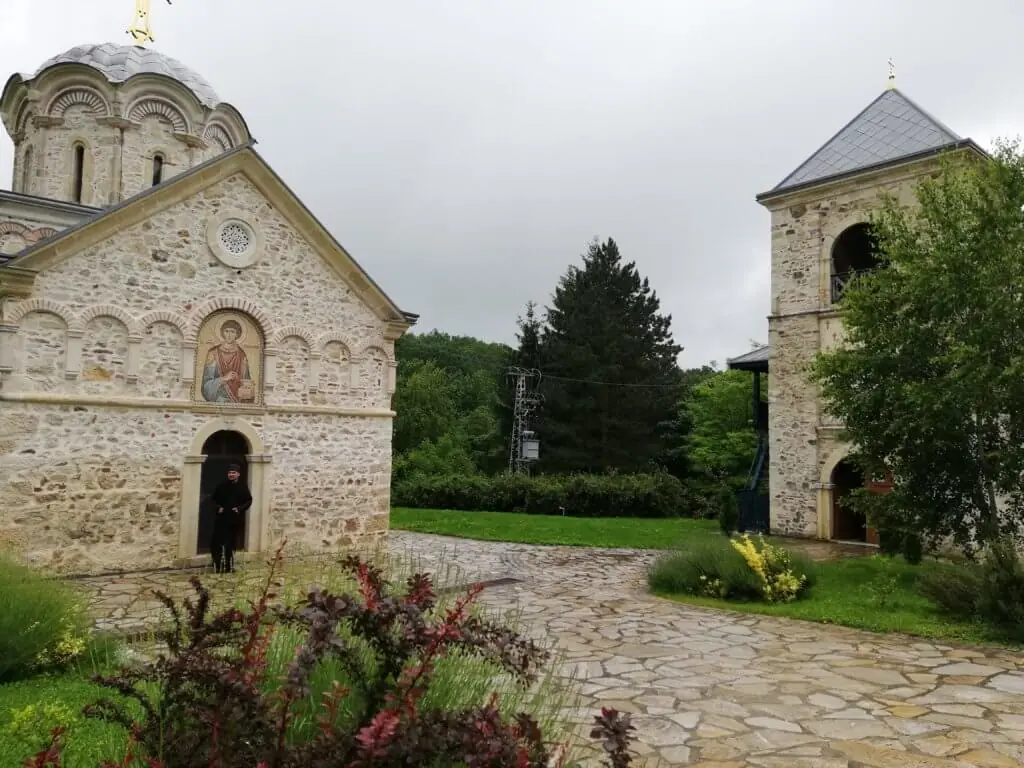
The most common mistake travelers make planning a Fruška Gora trip is trying to see too many monasteries in one day. The mountain has 16 of them, and online lists tend to suggest you can visit 5 or 6 in an afternoon. You can’t — not in any meaningful way. After driving clients through this region most weeks during the season, we’ve learned the lesson the easy way: two to three monasteries is the sweet spot for a day trip from Belgrade or Novi Sad. More than that and you start visiting parking lots, not monasteries.
This post is what we wish more travelers knew before booking. Which monasteries are actually worth the stop, how long each takes, what to wear, what’s free and what costs something, and how to combine the visit with Sremski Karlovci or Petrovaradin for a fuller day in Vojvodina.
Where Fruška Gora Is
Fruška Gora is a long, narrow mountain ridge in northern Serbia, between the Danube to the north and the Sava to the south. It’s the only real elevation in the otherwise flat Pannonian Plain — about 80 km long and rarely more than 15 km wide. Most of it is national park, with vineyards on the lower slopes and forest higher up.
The monasteries are scattered along the ridge, mostly on the southern side. From a driver’s perspective:
- About 70–90 km from Belgrade depending on which monastery — roughly 1 to 1.5 hours by car
- 15–30 minutes from Novi Sad
- 10–25 minutes from Sremski Karlovci
- About 80 km from Belgrade Airport (Nikola Tesla)
The roads through the park are generally good, but slow — narrow, winding, and shared with cyclists in the warmer months. The drive between two neighboring monasteries can easily take 20–30 minutes even when they’re only 10 km apart on the map.
A Quick History — Why So Many Monasteries on One Mountain
Most of the Fruška Gora monasteries were built between the 15th and 17th centuries, during a specific period when Serbia was under Ottoman rule and large numbers of Serbs migrated north into Habsburg territory. Fruška Gora became the spiritual heart of the displaced Serbian church — sometimes called the “Serbian Mount Athos.” The Branković family, the last Serbian despots, built or supported many of them.
At one point there were over 30 monasteries on the mountain. Today 16 remain active, and not all are equally worth visiting:
- Some are small village churches that happen to be called monasteries — fine if you’re already passing
- Some were damaged or neglected during different historical periods and are still in uneven condition today
- A few were heavily restored in the 1990s and 2000s and look polished but slightly artificial
- Four or five are historically and artistically the most significant — well preserved, and worth the drive
Realistically, those four or five are what most travelers actually want to see.
The Monasteries Worth Visiting First
Krušedol
The most prominent of the Fruška Gora monasteries. Founded between 1509 and 1514 by the Branković family, dedicated to the Annunciation. Often called the “spiritual beacon” of Fruška Gora, and significant enough to be engraved on the 5 dinar coin. Today it’s an active female monastery — nuns live and work here.
What makes it worth a stop:
- Burial place of an unusual collection of Serbian historical figures: the Branković family, two Serbian patriarchs (Arsenije III Čarnojević and Arsenije IV), Princess Ljubica Obrenović, and King Milan Obrenović
- Famous Baroque iconostasis with throne icons by Jov Vasilijevič
- The complex itself — red church-shaped entrance gate, chestnut trees, central church surrounded by konaks on four sides — is genuinely photogenic
- A small souvenir shop on the ground floor of the konak sells monastery honey, rakija, and other produce
Krušedol is the most natural first stop for anyone coming from Belgrade or Sremski Karlovci. Closest of the major monasteries to the highway. Free entry. Photos not allowed inside the church. Open during daylight hours.
Novo Hopovo
About 8 km from Krušedol. Founded in the late 15th or early 16th century. One of the most architecturally important monasteries on Fruška Gora — the church combines the medieval Serbian Morava style with later Baroque additions. The frescoes inside, painted around 1608 by an unknown master likely from Mount Athos, are among the best-preserved on the mountain.
Hopovo was historically a major cultural center — the seat of an episcopate, a monastery school, and for a time the residence of Dositej Obradović, the 18th-century writer and reformer who lived here as a young monk. The relics of Saint Theodore Tyron are kept here in a casket before the altar.
For travelers interested in Serbian church art and history, Hopovo is often the more interesting stop than Krušedol. For travelers who want one famous name, Krušedol still wins.
Grgeteg
About 5 km from Krušedol, in a small village surrounded by forest and meadows. Founded in 1471 by despot Vuk Grgurević. The most famous detail here is the iconostasis, painted by Uroš Predić in 1902 — Predić was one of the most important Serbian Realist painters of his generation, and the iconostasis is widely considered among his finest religious works.
Today an active female monastery. The whitewashed entrance with mosaic icons of saints and a vine-wrapped doorway makes for one of the better-known images of Fruška Gora. Photos inside the church are not allowed.
Vrdnik (Ravanica)
Worth mentioning because of its specific historical role — the relics of Prince Lazar, the Serbian ruler killed at the Battle of Kosovo in 1389, were kept here for over 250 years before being returned to the original Ravanica monastery in central Serbia in the 20th century. The monastery is in a quiet wooded valley near the village of Vrdnik. Less polished than Krušedol or Grgeteg, but historically significant for anyone interested in Serbian medieval history.
The Other 12
The remaining monasteries — Staro Hopovo, Beočin, Rakovac, Velika Remeta, Bešenovo, Petkovica, Šišatovac, Kuveždin, Đipša, Privina Glava, Jazak, Mala Remeta — vary widely in condition and scale. A few (Velika Remeta, Beočin) reward visitors with serious historical interest. Others are quiet rural sites that won’t add much to a one-day visit. Worth a stop only if you’re staying longer or have a specific reason to go.
What About Kovilj Monastery?
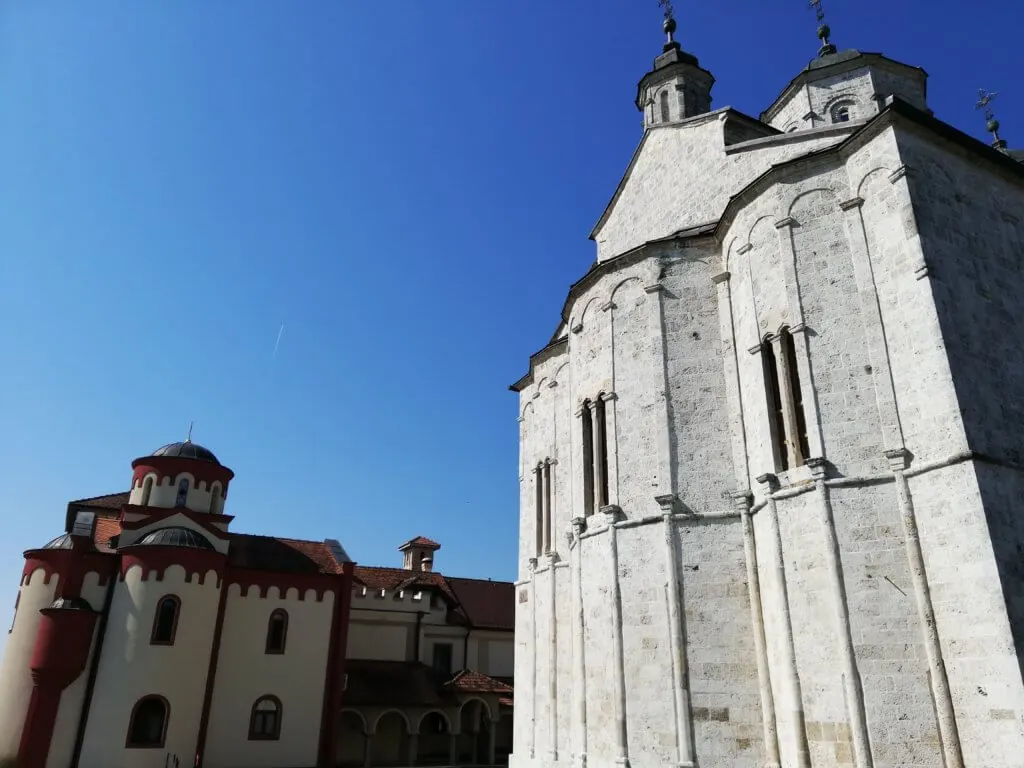
Kovilj often gets grouped with Fruška Gora online, but technically it isn’t on the mountain — it’s across the Danube in Bačka, about 25 km southeast of Novi Sad. According to tradition it was founded in the 13th century by Saint Sava himself, the first Serbian archbishop, and dedicated to the archangels Michael and Gabriel.
What makes Kovilj worth mentioning separately:
- The current church dates from the 18th century, but the site is much older
- The monks here are known for producing high-quality monastery rakija and honey, sold on site
- The location borders the Koviljsko-Petrovaradinski rit, a protected wetland reserve along the Danube — a rare ecosystem in this part of Europe
- Quieter than the main Fruška Gora monasteries, with less foot traffic
For travelers who want to combine a monastery visit with nature, Kovilj is the better choice than any of the main Fruška Gora ones. For travelers who want the famous names, it’s a detour.
What to Wear and What to Expect Inside
Serbian Orthodox monasteries have a dress code, and at the more visited ones it’s actually enforced. The general rules:
- Men: long trousers (no shorts), closed shoes, head uncovered
- Women: shoulders covered; a long skirt or dress is safest, though many monasteries are lenient with modest trousers; headscarf for entering the church
- At larger monasteries like Krušedol, scarves and wraps are usually available at the entrance to borrow
A few things to know inside:
- Photos inside the church are usually not allowed. This is true at Krušedol and Grgeteg specifically. Photos of the courtyard and exterior are fine.
- If a service is in progress, you can enter quietly but you should not walk around or photograph anything
- If you greet a monk or nun, the traditional Serbian greeting is “Pomaže Bog” (literally “may God help”). The reply is “Bog ti pomogao.” You’re not expected to know this — but it’s appreciated when foreign visitors do
- Most monasteries don’t charge an entrance fee. A small donation (a few hundred dinars in the donation box near the icons) is the norm if you’ve spent meaningful time there or taken something from the souvenir shop
How Long Each Monastery Takes
The honest answer most online guides won’t give you:
- Krušedol: 30–45 minutes — including the church, the iconostasis, the courtyard, and the souvenir shop
- Novo Hopovo: 30–40 minutes — fresco-focused visit, less courtyard wandering
- Grgeteg: 20–30 minutes — smaller complex, the main draw is the iconostasis
- Vrdnik: 20–30 minutes
- Kovilj: 30–45 minutes plus a stop at the rakija shop
Add 20–30 minutes of driving between most pairs. That’s why 3 monasteries is the realistic ceiling for a Fruška Gora half-day. 4 is doable only if you start early and skip lunch. 5 starts feeling like work.
How to Plan a Fruška Gora Day Trip
From Belgrade
The most efficient route: take the highway toward Novi Sad, exit at Inđija or Beška, and start at Krušedol first since it’s closest. From there you can chain to Grgeteg (5 km) and then Novo Hopovo (8 km from Grgeteg). Lunch at Krušedolka restaurant near Krušedol monastery, or push on to Sremski Karlovci for a more substantial meal. Driving time from Belgrade to the first monastery is about 1 hour outside rush hour.
From Novi Sad
Krušedol is 30 minutes by car. Novo Hopovo is 25 minutes. Grgeteg is 30 minutes. From Novi Sad you can comfortably do 3 monasteries and lunch in 4–5 hours total.
By private car
Possible but slower than it looks on the map. Roads through the park are narrow and winding, GPS sometimes routes you down forest tracks that aren’t really driveable, and signage between monasteries is inconsistent.
By bus
Buses from Novi Sad reach Irig and a few villages near the monasteries, but you’ll be walking 1–3 km from the bus stop to most of them, and the schedule won’t let you visit more than one in a day. Not realistic for foreign visitors.
With a private chauffeur
What we do most often. The advantage is real on this trip specifically — you skip the navigation headache through the park, you visit 3 monasteries comfortably in one half-day, and you don’t waste time at wrong turnoffs or closed gates. Door-to-door pickup, the route is built around what you actually want to see, and you can combine it with Sremski Karlovci or Novi Sad without re-planning. If you’re starting in Belgrade, this is best handled with a chauffeur from Belgrade; if you’re already in Novi Sad, our chauffeur from Novi Sad covers the same monasteries in less time and at a lower rate, since the drive in is shorter.
What We Often Combine With Fruška Gora
Most clients pair Fruška Gora with at least one of these:
- Sremski Karlovci wine tasting — the most popular combination by a wide margin. Two monasteries in the morning, lunch and 2 cellars in Karlovci in the afternoon. Karlovci sits at the eastern edge of the park, so the geography lines up.
- Novi Sad city center and Petrovaradin Fortress — for travelers who want a fuller Vojvodina day. Petrovaradin in the morning, monasteries and lunch in the afternoon. Around 9 hours from Belgrade.
- Krušedolka restaurant — close to Krušedol monastery, good for a casual lunch with a view over the surrounding nature. Solid Vojvodina food.
- Salaši (traditional Vojvodina farmsteads) — a few are scattered around the park edges and offer rustic lunches with house-made wine and rakija. Worth asking about if you want a longer meal.
The most balanced full day from Belgrade in our experience: Krušedol + Hopovo in the morning, lunch in Sremski Karlovci, 2 wine cellars in the afternoon. About 9 hours door-to-door, doesn’t feel rushed, and you’ll come back having seen the most important spiritual and culinary sites in Vojvodina.
Honest Take: Is Fruška Gora Worth a Full Day?
Depends on what you’re looking for.
If you’ve already seen big-name Serbian monasteries — Studenica, Sopoćani, Žiča — Fruška Gora will feel smaller and less dramatic. The mountain itself is gentle, the architecture is mostly Baroque rather than medieval, and individual monasteries are quick visits. Don’t come expecting Mount Athos.
If you haven’t seen them, or if you want to understand how the Serbian church survived under Ottoman rule by retreating north, Fruška Gora makes a lot more sense. Krušedol alone will give you the gist — the iconostasis, the historical burials, the layout — in 45 minutes. Adding Hopovo and Grgeteg fills in the picture.
The single best reason to come, in our experience, is the combination — monasteries + Sremski Karlovci wine + Petrovaradin Fortress all sit within a 30-minute drive of each other. Doing them together makes the day feel like a complete picture of Vojvodina rather than a checklist. Doing the monasteries alone, you may finish underwhelmed.
Skip Fruška Gora in deep winter unless you have a specific reason. Many monasteries reduce hours, the smaller ones can be hard to access, and the road conditions vary. April to October is the right window.
If you’re planning a Fruška Gora day trip from Belgrade or Novi Sad, with or without Karlovci and Petrovaradin, send us a message and we’ll build the route around the monasteries you most want to see and the time you have.
Interested in Fruška Gora private Tour?
Fruška Gora is easy to connect with the Novi Sad day-trip.

Related Posts

Belgrade Private Driver & Limo Service
The most popular taxi transfers from Belgrade Belgrade Airport to city center Belgrade to Budapest...

Ram Fortress: How We Plan Trips from Belgrade
At Balkan Chauffeur we drive guests through eastern Serbia almost every week, and Ram...

Golubac Fortress from Belgrade: Driver Advice for an Iron Gate Day Trip
At Balkan Chauffeur, Golubac is one of our most-requested day trips with a private driver from...

Private Tours from Belgrade
PRIVATE TOURS FROM BELGRADEMany travelers visiting Belgrade don’t realize how much more Serbia has...

Sremski Karlovci Wine Tasting: Our Chauffeurs’ Guide to Bermet and the Best Cellars
Sremski Karlovci wine tasting from Belgrade or Novi Sad. A practical guide to Bermet, the cellars, and how a private driver works.
